Last night I gave a public lecture as part of the Ottawa Historical Association's lecture series. You can listen to my talk here:
Showing posts with label Agricultural History. Show all posts
Wednesday, 24 February 2016
Friday, 19 February 2016
ORDC Seminar - The Early History of the Central Experimental Farm, 1886-1938.
This morning I gave a talk on the early history of the Central Experimental Farm as part of the Ottawa Research and Development Centre's seminar series. You can listen to it here:
Monday, 5 October 2015
My Articles on the 60 Acres Published Elsewhere
This list includes my writing on the transfer of 60 acres at the Central Experimental Farm published elsewhere, as of 6 October 2015. For a periodically updated summary of reactions to the 60 acres, please go to this page.
2015-10-06: "How Relocating a Hospital Could Compromise Canada's Agricultural Innovation." The Food Chain, TVO.
2015-07-17: "Experimental Farm Plan a Call to Action." The Ottawa Sun.
2015-06-22: "The Central Experimental Farm's Inclusion on Endangered Heritage Place List a Call to Action." ActiveHistory.
2014-11-20: "Vacating Science and Forgetting History at the Central Experimental Farm." ActiveHistory.
2014-11-13: "Protect the Central Experimental Farm." Ottawa Citizen.
Sunday, 23 November 2014
Crosspost: Vacating Science and Forgetting History at the Central Experimental Farm
This post originally appeared at Active History. As always, please leave comments at the original.
On November 3rd, John Baird announced
that Agriculture and Agri-Food Canada transferred approximately 24
hectares (60 acres) of the Central Experimental Farm, in Ottawa, to the
National Capital Commission. The NCC in turn offered to lease the land
to the Ottawa Hospital to build a new Civic Campus. The Hospital then mused about the using this new land as a parking lot.
| Pete Anderson posing near the threatened experimental plots with the Civic Hospital in the background. Photo credit: Laura Cameron. |
Thursday, 14 August 2014
/Kitchen Literacy/ in "The Westward-Moving House": A Joint Review
- Ann Vileisis, Kitchen Literacy: How we lost knowledge of where food comes from and why we need to get it back. (Washington, D.C.: Island Press, 2008.) Book Website.
- John Brinckerhoff Jackson, “The Westward-Moving House: Three American Houses and the People Who Lived in Them.” Places Journal, July 2011: Online. [Originally printed in Landscapes (2.3), Spring 1953.]
Food is essential to life. These two works, Ann
Vileisis’s Kitchen Literacy and John
Brinckerhoff Jackson’s “The Westward-Moving House,” focus on the social
histories and cultural geographies of people and places at seemingly opposite poles
of eating: the cooks and the farmers. This observation obscures the deep
similarities in the important stories Vileisis and Jackson tell about how we
have come to rely on distributed supply chains for our daily sustenance.
Friday, 25 July 2014
Rambling at the Farm: Walking Tours, History, Digital Humanities
I recently took my friend Kendall, a PhD candidate in history at Queen's University, on a rambling tour through the Central Experimental Farm. Over the course of an hour and a half and covering 6.5km, we jumped through the Euro-Canadian history of the site. While I didn't have a firm plan about where we'd go and what stories I'd tell, the route wound through some of my favourite spots and included an interweaving of apocryphal local legends, histories of the Farm system and of the city, descriptions of archival collections I've already worked with, and a discussion of the various methodologies I hope to apply as I get into my dissertation research.
Monday, 14 July 2014
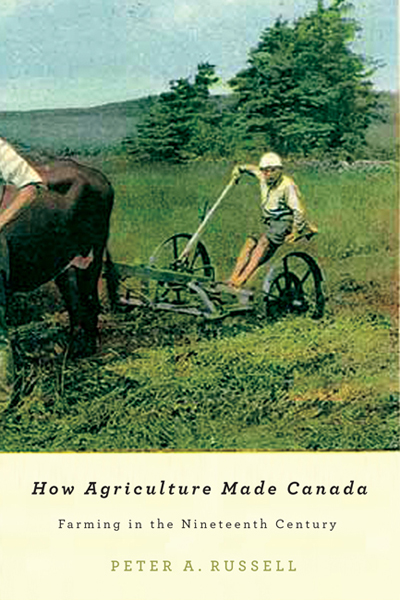
Crosspost: Review of Peter Russell's /How Agriculture Made Canada/
Note: This was originally posted at the Network in Canadian History and the Environment. Please leave comments on the original.
Reviewed By: Peter Anderson (Queen’s University)
Published: The Otter-NiCHE (July 2014)
Peter A. Russell, How Agriculture Made Canada: Farming in the Nineteenth Century. Montreal and Kingston: McGill-Queen’s University Press, 2012. 400 pp. ISBN 978-0-7735-4065-1. $34.95 (paper). Rural, Wildland and Resource Studies Series, Number 1.
Peter Russell argues that the settlement of the Prairies was shaped by the dynamics of two agricultural crises in nineteenth century Quebec and Ontario, which created a predominantly English Canadian context that later European immigrants assimilated to. As agricultural settlement reached the environmental and technological limits of the open land frontier in each province, farm communities and elites reacted in different ways. In Quebec the impulse was to turn inwards whereas in Ontario settlers looked west for a new frontier.
Reviewed By: Peter Anderson (Queen’s University)
Published: The Otter-NiCHE (July 2014)
Peter A. Russell, How Agriculture Made Canada: Farming in the Nineteenth Century. Montreal and Kingston: McGill-Queen’s University Press, 2012. 400 pp. ISBN 978-0-7735-4065-1. $34.95 (paper). Rural, Wildland and Resource Studies Series, Number 1.
Peter Russell argues that the settlement of the Prairies was shaped by the dynamics of two agricultural crises in nineteenth century Quebec and Ontario, which created a predominantly English Canadian context that later European immigrants assimilated to. As agricultural settlement reached the environmental and technological limits of the open land frontier in each province, farm communities and elites reacted in different ways. In Quebec the impulse was to turn inwards whereas in Ontario settlers looked west for a new frontier.
Wednesday, 21 August 2013
Town and City, Fairs and Exhibitions
Continuing from my thoughts about agricultural landscapes, I've been thinking about the places where agriculture intrudes directly into the city. From the point of view of Ottawa, and with the obvious exception of the Farm, the various branches of the Ottawa Farmers' Market are perhaps among the places where city dwellers contact farmers most directly.
Historically, while acknowledging the importance of the various traditional markets in Ottawa (the Byward and Parkdale being the two currently extant, though the Byward doesn't have a requirement for local produce) and the newer trend of Farmers' Markets, there's another site in the city that has hosted agricultural events: Lansdowne Park. In particular, Lansdowne Park used to be the site of the Central Canada Exhibition and the Ottawa Winter Fair, among other events.
Saturday, 3 August 2013
Thinking about Landscapes at the Central Experimental Farm
![]() |
| Central Experimental Farm 2013-08-03: Desire lines across a hay field. |
In less than a month I'll be moving to Kingston to start a PhD at Queen's University. I'll be exploring the ways that the Central Experimental Farm in Ottawa acts as an urban park and how urban residents experience and understand agricultural and rural places in the context of both the Farm and the Canadian Museum of Agriculture and Food--a topic inspired by my own experiences of the Farm in the decade since I moved to Ottawa. In preparation I've been thinking more and more about what these kinds of places and landscapes mean, and how to encounter them.
Subscribe to:
Posts (Atom)