Showing posts with label Environmental History. Show all posts

Thursday, 8 October 2015

CFP CHA2016: Invasions and Introductions

William Knight and I are seeking panelists for an environmental history panel on the history of plant and animal invasions and introductions (see draft panel abstract below) at the 2016 Canadian Historical Association annual meeting in Calgary, 30 May-1 June 2016. While our papers focus on plants and animals in late 19th and early 20th century Canada, we welcome contributions from different periods and geographic contexts.

If you are interested, send an email to peter.anderson@queensu.ca with a 250 word abstract for your paper as well as a 50 word summary to fit into the panel abstract. Please note that the deadline to submit for the CHA is October 15.

Panel Abstract
This panel explores the deliberate and accidental movement of plants and animals into and across environments, and their varying reception as welcome naturalization or alien invasion. Examining three examples from the late 19th and early 20th century, the panel considers the cultural and environmental reaction to species movements across different scales--physical, temporal, and conceptual. Building on Catriona Sandiland’s work on “dog stranglers in the park” (2013), these papers address the tensions between ideas of invasion and introduction, as well as the agency of plants and non-human animals in environmental history. Peter Anderson examines botanical exchanges between Canada and Great Britain and the ways in which botanists disciplined knowledge across imperial boundaries in an attempt to effect large-scale botanical introductions essential to colonization projects. The multi-directional movement of plant material within the British Empire redefined the meaning of individual plants in diverse geographical contexts. William Knight uses the introduction of bass to British Columbia to discuss both the large-scale reshaping of global fish faunas and the intensely local scale of impacts and reactions. Bass, for example, were perceived as either a welcome product of naturalization or aggressive invader depending when and where they were found.

Sandilands, C. (2013) “Dog Stranglers in the Park?: National and Vegetal Politics in Ontario’s Rouge Valley.” Journal of Canadian Studies. 47.3, Fall 2013. 94-122.

Thursday, 14 May 2015

#Envhist at CHA 2015

With less than a month to go before this year's meeting of the Canadian Historical Association at the University of Ottawa, and in the spirit of last year's list, I've trawled the CHA 2015 program for environmental history panels. The following list may be incomplete and environmental history is a broad and fluid subdiscipline so let me know if there's anything I missed.

Tuesday, June 2nd

8:30-10:00
  • Defining the Great Lakes-St Lawrence System: varying perspectives and scales
    • Facilitator /Commentator Alan MacEachern
    • Jamie Benidickson "From Boundary Waters to Water Boundaries: Legal dimensions of the Great Lakes-St Lawrence System."
    • Stephen Bocking "Invasive Species, Ecological Transformations, and the Formation of the Great Lakes-St Lawrence System." 
    • Stéphane Castonguay "Production cartographique, représentation scientifique et espace administratif: le system GL-SL comme imaginaire géographique.
    • Michèle Dagenais and Ken Cruikshank "Quelques pistes sur les études publiées sur les Grand Lacs-Saint-Laurent depuis 200 ans: un survol."
 10:30-12:00
  • Roundtable: Is All History Now Environmental History? The anthropocene in historical perspective.
    • Facilitator: Tina Loo
    • Participants: Daniel Macfarlane, Sean Kheraj, Stephen Bocking, Jessica DeWitt.
1:30-3:00
  • History and Environment
    • Facilitator/Commentator Gregory M.W. Kennedy
    • Gregory M.W. Kennedy "Building Resilience to Environmental Change in New Brunswick Coastal Communities Through Historical and Interdisciplinary Research."
    • Kristine Kowalchuk "Thomas Tyron and Bioregionalism: Learning from Early Modern England's Alternative Agriculture."
    • Yves Tremblay "Le fédéral, le provincial et le DDT: l'Expo 67 comme moment décisif de l'histoire de la sensibilité écologique au Canada."
  • What Kind of Development? Maritime Environmentalism and Regional Development Policy in the 1970s
    • Facilitator/Commentator Alan MacEachern
    • Mark Leeming "Local Economic Independence as Environmentalism: Nova Scotia in the 1970s."
    • Mark J. McLaughlin "Greening the System: The Conservation Council of New Brunswick's Responses to State Resource Development, 1969-1983."
    • Henry Trim "An Alternative on Prince Edward Island: Environmentalism, Modernization, and Sustainable Development."
  • Canadian Energy Histories: Kerosene, Coal and Oil
    • Facilitator/Commentator Steve Penfold
    • Sean Kheraj "On-Shore Oil Spills in Canada: Trans-Mountain Pipeline and the Interprovincial Pipeline, 1949-2012."
    • Ruth W. Sandwell "Searching for Light: Canada's Early Petroleum Industry, 1859-1900."
    • Andrew Watson "'The Tail Cannot Wag the Dog': Canadian Dependence on American Coal Between the Wars."
Wednesday, June 3rd 

8:30-10:00
  • Nationalism, Land, and Territory
    • Facilitator/Commentator Julien Labrosse
    • Cristina Ionita "Comment mettre la nation sur la carte: Nationalisme et cartographie dans l'Europe central avant la Première Gueere Mondiale."
    • Dinah Jansen "Size Matters: The Paris Peace Conference, Russian Liberals, and Russian Territorial Integrity, 1919"
    • Christopher Miller "Making Meaning in the Land: Remembering Expropriation through Oral History in Pickering, Ontario."
    • Xiaping Sun "Creating the Myth of the Wilderness: A Discursive Analysis of Maoist Land Reclamation in Northeast China." 
12:00-1:30
  • Exploration and Immigration in Canadian History
    • Facilitator/Commentator Katie Simanzik
    • Marilyn Braber and Murray Watson "Invisible Immigrants: The English in Canada since 1945."
    • Geoffrey Little "'This very extensive and almost unknown portion of the Empire': The Montreal Natural History Society's Surveys of Rupert's Land."
    • Gustavo Velasco "The Post, the Railroad and the State: New Approaches to study Western Canada Settlement, 1870-1900."
1:45-3:15
  • Sensory Encounters and Embodied Histories in the Fur Trade and Nineteenth-Century Northwest
    • Facilitator/Commentator Mary-Ellen Kelm
    • Daniel Robert Laxer "Sensing New Peoples: Diet, Dress, and Dance in the Western Fur Trade, 1760-1821."
    • Stacy Nation-Knapper "Feeling It: Sensory Experience of the Nineteenth-Century Columbia River Plateau Fur Trade."
    • Carolyn Podrunchny "Embodying Denial: The Vanishing Life of the Metis Giant from Willow Bunch, Saskatchewan, 1881-1904."
3:30-5:00
  • Indigenous Peoples, Labour, and Industrial Development in Canada
    • Facilitator/Commentator John Lutz
    • Anne R Janhunen "'A Regular Curse': Indigenous Labour and the Paradox of Early Twentieth-Century Industry in British Columbia's Fraser Valley."
    • Brittany A Luby "The International Joint Commission and the Woes of 'Civilized' Men: An Examination of Flood Damage Assessments and Compensatory Systems on Lake of the Woods, 1893-1925."
    • Daniel Rück "Industrial Development and Indian Act Moernity in Kahnawake, 1880-1935." 
  • Man and His Environment
    • Facilitator/Commentator Merle Massie
    • Stacey Alexopoulos "Surveying a Problem: Statistics and Housing Policy Development, 1958-1962."
    • Jessica DeWitt "Park Formation as Catalyst for Restoration: A Pennsylvania River's Ecological Revivification."
    • Adrian Gamble "Documenting the Canadian Arts and Crafts Movement: An Exercise in Interdisciplinarity."
    • Merle Massie "Grounding Science with History: Place methodology from the field." 
  • History, Interdisciplinarity, and the Indian Ocean World
    • Facilitator/Commentator Emmanuel Hogg
    • J. Pablo Arroyo-Mora "The Indian Ocean World Database: An interdisciplinary approach for understanding human-environment interactions."
    • Rashed Chowdhury "Russian Explorers in the Indian Ocean World in the Late Nineteenth Century."
    • Chinnaiah Jangram "Rethinking History in Indian Subcontinent: Politics of Identity and Writing History." 
  • L'histoire environnementale et les savoirs interdisciplinaires du passé
    • Animateur/Commentateur Stéphane Castonguay
    • Maude Flammard-Hubert "Explorer, inventorier, classified: la séparation des terres comme lieu de négociation interdisciplinaire."
    • Maude-Emmanuelle Lambert "Embellir et aménager les abords routiers: du Club des Habitants aux ingénieurs de l'État québécois, 1945-1960."
    • Valérie Poirier "'Choice between Automobile and Survival': la pollution automobile comme enjeu de santé publique, 1960-1970."

Of course no list is complete without some self promotion. My Ottawa (De)tour walking seminar "Finding Scientific Landscapes" will be running at 6pm from the Fletcher Wildlife Garden on June 3rd. (This is not part of Congress.) 

Friday, 30 January 2015

Domains of Literature - Historical Geographies of Canada and Agricultural Colonialism

This is part of a series of posts related to the domains of literature I covered in my qualifying exam. I am sharing it in hopes that it helps other students creating their lists. Please see the introductory post in the series for more details.

The first domain, the historical geography of Canada and agricultural settler colonialism, provides the national and international contexts of the Farm. As stated above, the Farm played an important role in the Canadian colonial project within the wider British Empire and with the backdrop of the expansion of the United States to the south. This domain looks beyond historical geographies of Canada to include readings in the growing fields of settler colonial studies, environmental history, and envirotechnical history. Uncovering the connections between agriculture, the environment, science, technology, Aboriginal communities and settlers, these readings provide the basis for a critical understanding of the Farm’s place in Canada as well as Canada’s place in wider imperial and colonial narratives.

This post has two main parts:
(1) The domain itself; and,
(2) A syllabus created as a thought experience while studying the list.

Tuesday, 30 December 2014

A Walk in the Farm - 60 Acres at Arpents 2014

This post is a modified version of my prepared talk at Arpents 2014. In my actual talk, I wandered widely from the prepared text so this account doesn't accurately represent that version. Such is a Pete Anderson presentation.

Looking north-east towards downtown from near the intersection Baseline and Merivale.

A couple of things happened since I agreed to give this presentation that changed the contours of what I originally planned to speak about. First in preparing for my qualifying exams, my research focus narrowed on the late nineteenth and early twentieth centuries limiting the methodological thrust of this presentation which was originally to be focused on the use of walking oral history interviews. Second, John Baird, the Minister of Foreign Affairs and the minister responsible for the National Capital Commission, recently made a direct attack on the geographic integrity of my research site, Ottawa's Central Experimental Farm.

Rather than looking at walking methodologies in historical geography research, then, I first outline the recent announcement by Baird and reactions to them--if you follow me on twitter this will be familiar to you. In the second section I argue that the pace of observation is an important factor in the ways different gazes are directed at the Farm.

Sunday, 23 November 2014

Crosspost: Vacating Science and Forgetting History at the Central Experimental Farm

This post originally appeared at Active History. As always, please leave comments at the original.

Pete at Farm with Civic in Background.jpg” with Caption: “Pete Anderson posing near the threatened experimental plots with the Civic Hospital in the background. Photo credit: Laura Cameron.
Pete Anderson posing near the threatened experimental plots with the Civic Hospital in the background. Photo credit: Laura Cameron.

On November 3rdJohn Baird announced that Agriculture and Agri-Food Canada transferred approximately 24 hectares (60 acres) of the Central Experimental Farm, in Ottawa, to the National Capital Commission. The NCC in turn offered to lease the land to the Ottawa Hospital to build a new Civic Campus. The Hospital then mused about the using this new land as a parking lot.

Friday, 14 November 2014

Op-ed: Protect the Central Experimental Farm

Central Experimental Farm looking towards the Windfield Towers, Personal Photograph.


My op-ed arguing against the development of the Central Experimental Farm, even for a hospital, can be found at the Ottawa Citizen. Please leave any comments on the original post.

Friday, 25 July 2014

Rambling at the Farm: Walking Tours, History, Digital Humanities


I recently took my friend Kendall, a PhD candidate in history at Queen's University, on a rambling tour through the Central Experimental Farm. Over the course of an hour and a half and covering 6.5km, we jumped through the Euro-Canadian history of the site. While I didn't have a firm plan about where we'd go and what stories I'd tell, the route wound through some of my favourite spots and included an interweaving of apocryphal local legends, histories of the Farm system and of the city, descriptions of archival collections I've already worked with, and a discussion of the various methodologies I hope to apply as I get into my dissertation research.

Monday, 14 July 2014

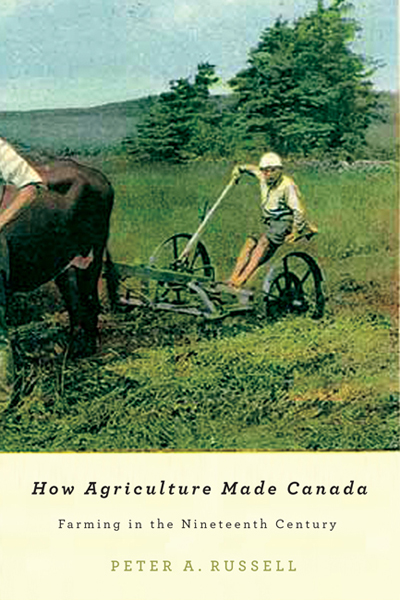
Crosspost: Review of Peter Russell's /How Agriculture Made Canada/

Note: This was originally posted at the Network in Canadian History and the Environment. Please leave comments on the original.


Reviewed By: Peter Anderson (Queen’s University)9780773540644

Published: The Otter-NiCHE (July 2014)

Peter A. Russell, How Agriculture Made Canada: Farming in the Nineteenth Century. Montreal and Kingston: McGill-Queen’s University Press, 2012. 400 pp. ISBN 978-0-7735-4065-1. $34.95 (paper). Rural, Wildland and Resource Studies Series, Number 1.

Peter Russell argues that the settlement of the Prairies was shaped by the dynamics of two agricultural crises in nineteenth century Quebec and Ontario, which created a predominantly English Canadian context that later European immigrants assimilated to. As agricultural settlement reached the environmental and technological limits of the open land frontier in each province, farm communities and elites reacted in different ways. In Quebec the impulse was to turn inwards whereas in Ontario settlers looked west for a new frontier.

Monday, 25 November 2013

Key Points and Questions for NICHE New Scholars Discussion, Wednesday, November 27, 2013: Wilderness and Waterpower: How Banff National Park Became a Hydroelectric Storage Reservoir by Christopher Armstrong and H.V. Nelles

(Note: This is a guest post by Jessica DeWitt discussing Armstrong and Nelle's book Wilderness and Waterpower.) 

In preparation for Wednesday's discussion I have organized a list of the points and arguments that struck me as most important in relation to Armstrong and Nelles' new book. To facilitate discussion I have attached most of these points to a possible question. I look forward to hearing other peoples' takes on the book.

1. Armstrong and Nelles open the book with a claim that hydroelectric power had as much of a effect on the development of Banff National Park as the CPR. After reading the book, do you think that they illustrated this claim effectively or is it an overstatement?

2. Two main questions that Armstrong and Nelles are seeking to answer:

a. "Why did Banff National Park have to be significantly altered to accommodate hydroelectric storage?" (vii)

b. "More broadly, how did the production and consumption of electricity in sourthern Alberta shape Canada's premier national park?" (vii)

3. The story is one that is supposed to illustrate the battle between "path-dependent technology" and public policy.
-"The phrase path dependence," they write, "describes a familiar predicament: early choices in system design virtually determine downstream incremental change." (viii)
Can we think of other examples of path dependence in environmental history? Is this a useful analytical concept for other studies?

4. Armstrong and Nelles emphasize that this is not a story of pre-determinism and that the results were the outcome of various decisions made by different factions.

5. They state that "there is no necessary incompatibility between power generation and a national park." Our conception of what a park is has evolved over time, what is deemed unsavory development today was considered a legitimate development at the turn-of-the-century. Do Nelles and Armstrong effectively demonstrate this evolution? They use the term "Doctrine of Usefulness" to explain why Calgary Power was able to dig its claws into Banff. Does their use of the "Doctrine of Usefulness" agree with Robert Craig Brown's original definition or are they trying to apply it in a broader manner? Does the doctrine work in this instance?

6. Armstrong and Nelles state that a increased demand in power was a result of a kind of social gospel status surrounding electrification. Is this factor given enough attention in the book? Or does it get lost behind a story of decades of political manoeuvring? 

7. They mention that much of this situation can be attributed to Canadians ambivalence towards the natural world in which they live. Since I'm not Canadian, I would love to hear some Canadian opinions on this assertion, which I have run into in numerous Canadian environmental histories.

8. What do you think of the definition of wilderness that Armstrong and Nelles choose to work with?
"The problem of wilderness is that creating an imaginary separation between humanity and nature masks the essential humanness of its construction." (xiii) <-I like this quote.

9. They mention that waterpower exists in a cultural context. Not every waterfall, they say, is dammed. Society makes culturally informed decisions about what happens to each waterfall and how it will meet its energy requirements.

10. They emphasize that the reengineering of the Bow was necessary if it were to be used for waterpower because of the unreliability of its flow (heavy during Spring thaw, low at other times of year).

11. I saw a lot of parallels between their treatment of hydroelectric power development on the Bow and Nelles' The Politics of Development, particularly in regards to discussions of possible provincial and private cooperation. Have the rest of you read The Politics of Development and if so do did you notice the similarities? Also, perhaps we could discuss the connection of this book to their earlier work, The River Returns.

12. Nelles and Armstrong state that they are using the concept of second nature. How effectively did they apply this concept to their narrative? Could they have given this idea more attention? (I say, yes)

13. I found it interesting how the hydroelectric developments and other development were deemed acceptable if they were hidden. Although there is an assertion that resistance to such development in parks has developed since the mid-twentieth century. Is it true that the out of sight, out of mind attitude is still alive and well in our parks and protected areas?

14. I especially enjoyed the portion of the book that dealt with the Spray Lakes. Concluding this portion of the story, they write, "the argument that hydroelectric development should not take place within national parks, a point of view that seemed to gain wide public acceptance, when forced through the sausage machine of federal politics in the late 1920s, led to the remarkable conclusion that such places should not be within national parks in the first place." (115)

I looked at a current map of the region in order to gain a better understanding of where the Spray Lakes were and the positioning of the four national parks that were made out of Rocky Mountains National Park in order to cut out those pieces of land that were natural resource rich. What I found most interesting is that the Spray Lakes which were cut of Banff are now surrounded by 4-5 provincial parks. This relates directly to my research on provincial parks. What does this tell us about the values/expectations we place on national vs. provincial parks?

15. This book also fed my growing fascination with Canadian and American's acceptance of dams. So many parks, particularly at the provincial and state level are designed around an artificial lake, treating the lake as a natural landmark. What does this say about our understanding of nature and the relationship between recreation and the natural world?

16. In their conclusion, Armstrong and Nelles talk once again about the way in which people reconstructed their conception of nature in order to accept the presence of hydroelectric technology in their parks. They also reassert that humans are a part of nature and that the Bow was not "natural" before the hydroelectric development. This development, they state, was "relative rather than absolute change"

As I finished the book I found myself wishing they had put more emphasis on these two themes instead of going into the minutiae of the political and economic events surrounding the hydroelectric development.  Did anyone else come to the same or similar conclusion?

-Well, I could go on--and on--but I'll wait until Wednesday.


Saturday, 19 October 2013

Thoughts on Nature's Metropolis


Bill Cronon's Nature's Metropolis is a long, layered book. Just shy of 400 pages (plus numerous insets that are interesting though would be more so if they were incorporated into the work), Cronon provides a detailed environmental history and historical geography not just of the city of Chicago but of the vast regions of the American west that became its hinterland during the latter two thirds of the nineteenth century. I've heard numerous scholars and graduate students cite this work as their gateway into environmental history and after reading it I'm left feeling that if I wasn't already part of the choir, I'd also be one of its converts.

Wednesday, 21 August 2013

Town and City, Fairs and Exhibitions

Continuing from my thoughts about agricultural landscapes, I've been thinking about the places where agriculture intrudes directly into the city. From the point of view of Ottawa, and with the obvious exception of the Farm, the various branches of the Ottawa Farmers' Market are perhaps among the places where city dwellers contact farmers most directly.

Historically, while acknowledging the importance of the various traditional markets in Ottawa (the Byward and Parkdale being the two currently extant, though the Byward doesn't have a requirement for local produce) and the newer trend of Farmers' Markets, there's another site in the city that has hosted agricultural events: Lansdowne Park. In particular, Lansdowne Park used to be the site of the Central Canada Exhibition and the Ottawa Winter Fair, among other events.

Saturday, 3 August 2013

Thinking about Landscapes at the Central Experimental Farm


Central Experimental Farm 2013-08-03: Desire lines across a hay field.

In less than a month I'll be moving to Kingston to start a PhD at Queen's University. I'll be exploring the ways that the Central Experimental Farm in Ottawa acts as an urban park and how urban residents experience and understand agricultural and rural places in the context of both the Farm and the Canadian Museum of Agriculture and Food--a topic inspired by my own experiences of the Farm in the decade since I moved to Ottawa. In preparation I've been thinking more and more about what these kinds of places and landscapes mean, and how to encounter them.

Monday, 8 April 2013

Crosspost: The Politics of Place: Local history and the Megaproject


Note: This review was written for and originally posted at Active History on March 14, 2013. I encourage anyone interested in commenting to leave a note on the original paper.

Sensing Changes: Technologies, Environment, and the Everyday, 1953-2003
Joy Parr
University of British Columbia Press
Paperback, 304 pages, $32.95

Sensing_Changes_300Just as all politics can be viewed as local, so, too, can history. Joy Parr’s Sensing Changes: Technologies, Environments, and the Everyday, 1953–2003 (UBC Press, 2010) explores local reactions to a series of “megaprojects,” with a focus on how the residents and workers involved adapted to changing environments, technologies, and everyday experiences often outside of their control. Through seven diverse episodes—ranging from the creation of CFB Gagetown in New Brunswick, the building of the Saint Lawrence Seaway in eastern Ontario, the flooding of the Arrow Lakes in British Columbia, three aspects of Canada’s nuclear program, and the local and provincial response to the e.coli outbreak in Walkerton, Ontario in 2001—Parr seeks to reclaim the vital importance of local, embodied experience in historical research and writing, and, by extension, in political and policy decision-making processes.