On Thursday, November 13th and Friday, November
14th Mike Hulme gave two public lectures at Carleton University. Hulme is a
Professor of Climate and Culture in the Department of Geography at University
of King’s College and after a career working as a climatologist at the
University of East Anglia is now making a transition to being a human (and in
particular a cultural) geographer.
Saturday, 15 November 2014
Friday, 14 November 2014
Op-ed: Protect the Central Experimental Farm
 |
| Central Experimental Farm looking towards the Windfield Towers, Personal Photograph. |
My op-ed arguing against the development of the Central Experimental Farm, even for a hospital, can be found at the Ottawa Citizen. Please leave any comments on the original post.

Crosspost: Graduate School and the Consulting Historian
This
was originally posted at History@Work, the blog of
the National Council for Public History. Please leave comments at the original.
Academic
careers are hard to come by these days. Public historians will not be surprised
by the posts on the active #altac hashtag on Twitter or the Social Science
and Humanities Research Council of Canada’s (SSHRC) recent “White Paper on the Future of the PhD in the Humanities”
that observed that only between 10 and 15 percent of those who enter PhD
programs will be employed at a post-secondary institution [1]. A declining
number of tenured and tenure-track positions, coupled with an increased
reliance on precarious labor in the form of adjunct and temporary appointments,
has destabilized the academic job market for graduates. Deep budget cuts to
museums, archives, and other research-oriented institutions–not just in history
and the humanities, but also in the social, physical, and life sciences–make
finding “traditional” public history jobs increasingly difficult as well.
Thursday, 14 August 2014
/Kitchen Literacy/ in "The Westward-Moving House": A Joint Review


- Ann Vileisis, Kitchen Literacy: How we lost knowledge of where food comes from and why we need to get it back. (Washington, D.C.: Island Press, 2008.) Book Website.
- John Brinckerhoff Jackson, “The Westward-Moving House: Three American Houses and the People Who Lived in Them.” Places Journal, July 2011: Online. [Originally printed in Landscapes (2.3), Spring 1953.]
Food is essential to life. These two works, Ann
Vileisis’s Kitchen Literacy and John
Brinckerhoff Jackson’s “The Westward-Moving House,” focus on the social
histories and cultural geographies of people and places at seemingly opposite poles
of eating: the cooks and the farmers. This observation obscures the deep
similarities in the important stories Vileisis and Jackson tell about how we
have come to rely on distributed supply chains for our daily sustenance.
Saturday, 2 August 2014
Bureaucratic Ruins: Images from the Last Days of the Sir John Carling Building
Friday, 25 July 2014
Rambling at the Farm: Walking Tours, History, Digital Humanities

I recently took my friend Kendall, a PhD candidate in history at Queen's University, on a rambling tour through the Central Experimental Farm. Over the course of an hour and a half and covering 6.5km, we jumped through the Euro-Canadian history of the site. While I didn't have a firm plan about where we'd go and what stories I'd tell, the route wound through some of my favourite spots and included an interweaving of apocryphal local legends, histories of the Farm system and of the city, descriptions of archival collections I've already worked with, and a discussion of the various methodologies I hope to apply as I get into my dissertation research.
Monday, 14 July 2014
Crosspost: Review of Peter Russell's /How Agriculture Made Canada/
Note: This was originally posted at the Network in Canadian History and the Environment. Please leave comments on the original.
Reviewed By: Peter Anderson (Queen’s University)
Published: The Otter-NiCHE (July 2014)
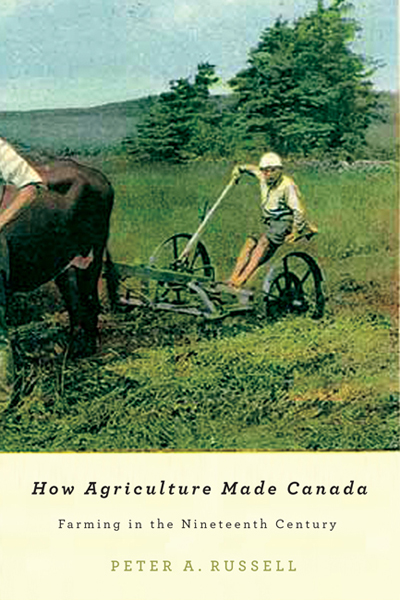
Peter A. Russell, How Agriculture Made Canada: Farming in the Nineteenth Century. Montreal and Kingston: McGill-Queen’s University Press, 2012. 400 pp. ISBN 978-0-7735-4065-1. $34.95 (paper). Rural, Wildland and Resource Studies Series, Number 1.
Peter Russell argues that the settlement of the Prairies was shaped by the dynamics of two agricultural crises in nineteenth century Quebec and Ontario, which created a predominantly English Canadian context that later European immigrants assimilated to. As agricultural settlement reached the environmental and technological limits of the open land frontier in each province, farm communities and elites reacted in different ways. In Quebec the impulse was to turn inwards whereas in Ontario settlers looked west for a new frontier.
Reviewed By: Peter Anderson (Queen’s University)
Published: The Otter-NiCHE (July 2014)
Peter A. Russell, How Agriculture Made Canada: Farming in the Nineteenth Century. Montreal and Kingston: McGill-Queen’s University Press, 2012. 400 pp. ISBN 978-0-7735-4065-1. $34.95 (paper). Rural, Wildland and Resource Studies Series, Number 1.
Peter Russell argues that the settlement of the Prairies was shaped by the dynamics of two agricultural crises in nineteenth century Quebec and Ontario, which created a predominantly English Canadian context that later European immigrants assimilated to. As agricultural settlement reached the environmental and technological limits of the open land frontier in each province, farm communities and elites reacted in different ways. In Quebec the impulse was to turn inwards whereas in Ontario settlers looked west for a new frontier.
Subscribe to:
Posts (Atom)